Wayne Zurl grew up on Long Island and retired after twenty years with the Suffolk County Police Department, one of the largest municipal law enforcement agencies in New York and the nation. For thirteen of those years he served as a section commander supervising investigators. He is a graduate of SUNY, Empire State College and served on active duty in the US Army during the Vietnam War and later in the reserves. Zurl left New York to live in the foothills of the Great Smoky Mountains of Tennessee with his wife, Barbara.
Twenty (20) of his Sam Jenkins mysteries have been published as eBooks and many produced as audio books. Ten (10) of these novelettes are available in print under the titles: A Murder In Knoxville and Other Smoky Mountain Mountain Mysteries and Reenacting A Murder and Other Smoky Mountain Mysteries. Zurl has won Eric Hoffer and Indie Book Awards, and was named a finalist for a Montaigne Medal and First Horizon Book Award. His full length novels are available in print and as eBooks: A New Prospect, A Leprechaun's Lament, Heroes & Lovers, and Pigeon River Blues.
For more information on Wayne’s Sam Jenkins mystery series see www.waynezurlbooks.net. You may read excerpts, reviews and endorsements, interviews, coming events, and see photos of the area where the stories take place.
Connect with Wayne Zurl:
About The Book

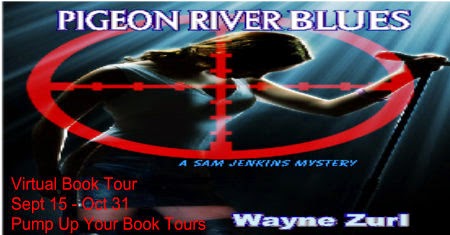
Title: Pigeon River Blues
Author: Wayne Zurl
Publisher: Iconic Publishing
Publication Date: May 31, 2014
Pages: 258
ISBN: 978-1938844027
Genre: Mystery / Police Procedural
Format: eBook / PDF / Paperback
Winter in the Smokies can be a tranquil time of year—unless Sam Jenkins sticks his thumb into the sweet potato pie.
The retired New York detective turned Tennessee police chief is minding his own business one quiet day in February when Mayor Ronnie Shields asks him to act as a bodyguard for a famous country and western star.
C.J. Profitt’s return to her hometown of Prospect receives lots of publicity . . . and threats from a rightwing group calling themselves The Coalition for American Family Values.
The beautiful, publicity seeking Ms. Proffit never fails to capitalize on her abrasive personality by flaunting her lifestyle—a way of living the Coalition hates.
Reluctantly, Jenkins accepts the assignment of keeping C.J. safe while she performs at a charity benefit. But Sam’s job becomes more difficult when the object of his protection refuses to cooperate.
During this misadventure, Sam hires a down-on-his-luck ex-New York detective and finds himself thrown back in time, meeting old Army acquaintances who factor into how he foils a complicated plot of attempted murder, the destruction of a Dollywood music hall, and other general insurrection on the “peaceful side of the Smokies.”
For More Information:
Can you tell us what your book is about?
I
think the summary I used to sell the publisher on reading the entire manuscript
will give you the gist of what the story is about. Beyond that, I’m getting
into question 2 and why I wrote the book. Here’s the summary:
Winter
in the Smokies can be a tranquil time of year—unless Sam Jenkins sticks his
thumb into the sweet potato pie.
The retired New York detective turned Tennessee police
chief is minding his own business one quiet day in February when Mayor Ronnie
Shields asks him to act as a bodyguard for a famous country and western star.
C.J. Profitt’s return to her hometown of Prospect
receives lots of publicity . . . and threats from a rightwing group calling
themselves The Coalition for American Family Values.
The beautiful, publicity seeking Ms. Proffit never
fails to capitalize on her abrasive personality and flaunt her lifestyle—a way
of living the Coalition hates.
Reluctantly, Jenkins accepts the assignment of keeping
C.J. safe while she performs at a charity benefit. But Sam’s job becomes more
difficult when the object of his protection refuses to cooperate.
During this misadventure, Sam hires a down-on-his-luck
ex-New York detective and finds himself thrown back in time, meeting old Army
acquaintances who factor into his plan to foil a complicated plot of
premeditated murder, the destruction of a Dollywood music hall, and other
general insurrection on the “peaceful side of the Smokies.”
Why did you write your book?
Most
of what I write comes from personal experiences. I have more of a memory than imagination. But
I do fictionalize and embellish everything to make it more readable and not
sound like a detective’s report. Real police work is not always a thrill a
minute. With that in mind, I often
conjoin two or more actual incidents to build one more interesting novel. That’s
the case with Pigeon River Blues.
My books and stories are
character driven. Cops are in the people business and any good detective who
worked in a crowded and busy area met his/her share of quirky, story-worthy
characters.
In PRB, I really wanted
to incorporate the three nitwits that made up the local segment of what I
called The Coalition for American Family Values—Mack and Ma Collinson and their
henchman, the head case, Jeremy Goins. I really met these people. And they
threw me for a loop. These numbskulls were functioning in the mainstream world,
but were certified whack jobs. I felt a compelling need to introduce them to
the literary world.
And I’ve been looking
for the appropriate place to introduce a new regular character to the cast of
the Sam Jenkins mysteries and give him a job at Prospect PD. I call him John
“Black Cloud” Gallagher and this outwardly goofy and malapropic guy, who speaks
a language all his own, is based on someone with whom I worked for many years.
Despite all the laughs he provided me and the office full of cops, when “John”
dropped the class clown act, he worked like one hell of an investigator.
Can you tell us a little about your main and
supporting characters?
The
main character in all my mysteries is Sam Jenkins, a former New York detective
lieutenant who, after years of retirement, begins a second career as police
chief in Prospect, Tennessee, a small touristy city in the foothills of the
Great Smoky Mountains. Sam is supported by Sergeants Bettye Lambert who Sam
calls the most beautiful desk sergeant on the planet, Stan Rose, a former LAPD
officer who followed his wife back to her home town and joined Prospect PD, and
Sam’s wife Kate who’s spent many years acting as Sam’s Dr. Watson. Other
regulars not usually associated as friends of your average policeman are FBI
Special Agent Ralph Oliveri and TV reporter Rachel Williamson who often factor
into Sam’s investigations.
Do you tend to base
your characters on real people or are they totally from your imagination?
I write with a lot of dialogue. It makes a story read faster and it’s a
better way to handle the exposition of facts in a “show don’t tell” way. And
I’m compulsive and freaky about getting the dialogue to sound natural and
realistic because I hate to read stilted, phony, or unnatural speech. So, if
I’m not the most naturally brilliant of writers, how can I assign each
character a unique voice and write their lines fluidly? I hold a casting call
while I’m writing my stories. If the “real” story doesn’t have enough “real”
characters to make it good fiction, I try to remember someone from my past who
would lend something positive to the atmosphere—someone different, memorable,
and quirky. If I can remember them, see them, hear them, I can duplicate the
sound of their speech, their delivery, and write their realistic dialogue.
Transposing personalities happens a lot because I transplant actual happenings
from New York to Tennessee. In doing that, I can’t write a character’s dialogue
with him sounding like someone from Brooklyn when my protagonist works at a
police department in southern Applaachia. To have a character called Cloyd
Minton and not Vito Cavitelli say, “Ey, howz it goin’?” rather than, “You doin’
aw rot t’day?” would cause me to lose credibility.
Are you consciously aware of the plot before
you begin a novel or do you discover it as you write?
I
once read that try as anyone may, there are only eleven basic plots or
storylines to choose from. They can be used simply, enhanced by combining them,
made complex or convoluted by imagination, but plots are plots. I say, “Plotz,
schmotz.” I start out with what really happened—something on record in the real
world. But remember what I said? Reality ain’t always that interesting. Occasionally,
it may be stranger than fiction, but it’s rarely more complex or exciting. It
also doesn’t always contain the internal conflict and tension publishers (and
some readers) demand. So, writers must embellish, add tidbits of tension, make
the reader grit his/her teeth and say, “Jeez, Sam, you’re a good cop. Why are
you doing that?” It’s because the story (read modern publisher) wants it.
Am I aware of all the plot elements
before I sit down with a pad and pen and attack a story? No. Writing is fun.
Outlining and excessive aforethought is too much like work. I know the basics.
I rough out a book or story and then go back and “flesh out” the descriptions I
forgot because I was rushing to get my thoughts on paper. I add extraneous bits
of conflict and tension and perhaps, toss in a red herring or two.
Does the setting play
a major part in the development of your story?
I’ve tried to do for the Smoky Mountain region of east Tennessee what
Raymond Chandler did for Los Angeles, Tony Hillerman did for northern Arizona,
and James Lee Burke does for southern Louisiana—give the places character
status.
The indigenous people of the Smokies are different than those from Long
Island or Manhattan or Canada, or Cedar rapids, Iowa. They are unique. Their
names are different. They speak differently and in many regards, they react
differently to situations. I want a local reader to say, “Boy howdy, he’s got
them characters down cold.” Or an outsider to say, “I vacationed in the Smokies
once and I believe he’s captured the flavor of the region.”
Have you suffered from writer’s block and what
do you do to get back on track?
Sure, there are times
when I can’t dream up a nifty connection or a believable red herring to save my
life. To get past that, I usually uncork a better than average bottle of wine,
grab two glasses, and invite my wife to help solve my problem. She’s pretty
good.
What do you like the most
about being an author?
When the ideas are
flowing, writing is lotsa fun. Ending up with what I consider a good finished
product is very satisfying. Hearing a reader compliment one of my books or
stories eloquently is truly great stuff.
What is the most pivotal point of a writer’s
life?
Receiving
your first signed contract. Even if you’re very good, before you’re on the
books as a pro, you’ve just been trying or dabbling. Once you not only see the
light at the end of the tunnel, but can touch it, you change your focus from
finding someone to believe in you and take a chance on your writing to worrying
if your work will sell and how you can assist in promoting it and you.
What kind of advice
would you give other fiction authors?
The best practical
advice about writing I’ve seen came from an interview with Robert B. Parker.
When asked why so many people like his stories, he said, “Because they sound
good.”
From writing so many
novelettes destined for audio books, I know what he means. But even if you have
no intention to produce your book in audio form, you owe it to your readers to
make your stories sound good. It doesn’t matter if you’ve adhered to all the
rules of good grammar and usage and all the maxims of structure if your writing
doesn’t sound good when read.
When
you think your story, novelette, novella, novel, or epic is finished, when you
truly believe you’ve found and corrected all the typos and nits and it’s ready
to sell, go back and read it aloud to yourself. Pretend you’re the star of your
own audio book. Read it slowly and professionally as an actor would. Then, ask
yourself, does it sound good? Do all the paragraphs smoothly transcend to the
next? Does each sentence contain the right number of syllables? Does each word
flow into the next without conflict?
Does it have a pleasing rhythm? Basically, does it sing to you? For a
guy who doesn’t dance very well, I have a great need for rhythm in my writing.
If you notice any “bumps,” go back and rewrite it. Smooth everything out. If
something bothers you now, it will annoy the dickens out of you in the future
and someone else will probably notice it, too. When that’s finished hand it off
to an editor or proofreader, whomever you can afford, and get a second pair of
eyes to read it. EVERYONE needs someone else to check their work.