Showing posts with label religion. Show all posts

Interview with John Herrick, Author of 'Between These Walls'

A self-described "broken Christian," John Herrick battled depression since childhood. In that context, however, he developed intuition for themes of spiritual journey and the human heart.

Herrick graduated from the University of Missouri—Columbia. Rejected for every writing position he sought, he turned to information technology and fund development, where he cultivated analytical and project management skills that helped shape his novel-writing process. He seized unpaid opportunities writing radio commercial copy and ghostwriting for two nationally syndicated radio preachers.

The Akron Beacon Journal hailed Herrick's From the Dead as "a solid debut novel." Published in 2010, it became an Amazon bestseller. The Landing, a semifinalist in the inaugural Amazon Breakthrough Novel Award contest, followed.

Herrick's nonfiction book 8 Reasons Your Life Matters introduced him to new readers worldwide. The free e-book surpassed 100,000 downloads and hit #1 on Amazon's Motivational Self-Help and Christian Inspiration bestseller lists. Reader response prompted a trade paperback.

Herrick, who is at work on his next novel, admits his journey felt disconnected. "It was a challenge but also a growth process," he acknowledges. "But in retrospect, I can see God's fingerprints all over it."

Q: Please tell us about Between These Walls, and what inspired you to write it.

A: Thanks for letting me stop by! A few years ago, I caught a television news story about a high school student who had endured an onslaught of bullying because he was gay. He was on the verge of suicide—tired, desperate, filled with pain. The news story centered around a video the student had posted online. In the video, the only way he could bring himself to express his hurt was to page through words he’d written in black marker on sheets of paper. Here sat a kid who looked like an average high school freshman, wiping tears from his eyes, seeking someone to hear his cry for help.

My heart broke for that kid. I’ve never met him. I don’t know if he’s alive today. But I’ll never forget him. I thought to myself, “Nobody that age should know what it’s like to feel that kind of pain.” A high-level concept for Between These Walls already resided in the back of my mind, but the heartbreak I felt for that kid was my catalyst for action. That evening, I resolved to pursue Between These Walls.

Q: What themes do you explore in Between These Walls?

A: I love stories that inject faith into the tough questions of life. In Between These Walls, my main character, Hunter Carlisle, is a Christian with a secret attraction to other men. Much of Hunter’s journey is rooted in the fear and isolation he felt while coming of age, so Between These Walls ties those past experiences into his life as a 26-year-old adult today. The novel takes readers to the crossroads of faith and love, and digs deep into the internal turmoil of a man with a secret. It explores homosexuality and its impact upon one individual’s heart, soul, mind, and emotions. It also challenges readers to consider the pain that might lie beneath the surface of what we see.

Q: Why do you write?

A: I write because I die a slow death inside if I don’t. I love the writing process, but writing itself feels like lifeblood flowing through me. It’s a “must” for me, but a good kind of “must.”

Q: How picky are you with language?

A: What a great question! My top priority is to make sure my words flow from the heart. I don’t write to win awards; I write for people, including those who struggle. For me, the dialogue must be realistic, and the prose must reflect the personality of the character whose point of view I’ve adopted. Those factors drive how strict or flexible I am with words.

Q: When you write, do you sometimes feel as though you were being manipulated from afar?

A: My best concepts seem to come when I don’t seek them. A character will arise in my heart, grab hold of me, and won’t let go until I tell his story. If I ignore him, he tugs harder until I relent. I believe it means someone needs that character’s story. The process fascinates me. It’s like walking through a small miracle.

Q: What is your worst time as a writer?

A: With every book, I face a fear that I’ll sit down to write or plan a novel and nothing will come forth—which, for a writer, feels like failure. No matter how many books I’ve written, the same fear arises. Yet it has proven an irrational fear. I’ve discovered if I simply show up and put my fingers to the keyboard, something will come forth.

Q: Your best?

A: Hearing from a reader who says a book has impacted his/her life. Yes, I love the feeling of accomplishment that comes with the completion of a book project, but the privilege of touching someone’s life—the rewards don’t get better than that.

Q: Is there anything that would stop you from writing?

A: I’m a firm believer in the adage, “Where there’s a will, there’s a way.” With rare exception, you can find the time or resources you need to take your next step—though it might take a little creativity to dig it up. I’ve discovered one key to writing is to do it anyway: If you’re afraid, do it afraid. If you’re depressed, do it depressed. If you feel like a failure, do your best and pray that God will use it anyway.

Q: What’s the happiest moment you’ve lived as an author?

A: The moment I saw my first book in print and held it in my hands. I’d waited 25 years for that moment!

Q: Is writing an obsession to you?

A: Yes! When you’re a writer at heart, a fire burns in you. You need to release it. If I go too long without writing, I feel like I die a slow death inside. That sounds melodramatic, but it’s precise: A deadness settles in, and it drains the life out of me, ounce by ounce, until I rekindle the fire.

Q: Are the stories you create connected with you in some way?

A: My novels are not autobiographical, per se. That said, I believe a piece of the author winds up in every story, and I’m no exception. Sometimes I’ll draw on a past experience or background detail to help shape a character. But I believe an author works himself into his stories on a subconscious level, too: An author’s personality might lurk in various corners of his prose, or he might channel his emotions into a character’s dilemma.

Q: Ray Bradbury once said, “You must stay drunk on writing so reality cannot destroy you.” Do you agree?

A: Let me put it this way: Although I love to create stories and dig down into characters, the process has also proven therapeutic for me. I’ll channel my emotions into the character’s struggle, where the emotions are similar but the circumstances or struggle are different.
For example, in my novel The Landing, the main character, Danny Bale, has grown frustrated with unrequited love and is on the verge of abandoning his dreams. When I wrote that novel, I wasn’t struggling with that scenario—and I certainly didn’t live at the beach or perform music on weekends like he did! But I dealt with a lot of frustration and anger as it related to my job at the time, so Danny’s frustration and anger became a symbol of my own. So yes, when reality gets me down, writing becomes a haven where I can sort through the mess. Plus, showing up for book work adds a steady rhythm to each day. Jobs, circumstances and relationships change, but writing is one of my few constants.

Q: Where is your book available?

A: You can find it at Amazon and the usual retail outlets. If they don’t have it on the shelf, they can get it for you. And a sidenote here: My nonfiction book, 8 Reasons Your Life Matters, can be found as a free e-book at most retailers.

Q: Do you have a website or blog where readers can find out more about you and your work?

A: My website is www.johnherrick.net. My blog is johnherricknet.blogspot.com. I’m also on Facebook and Twitter. I love interacting with readers!

Interview with John Lawson, Author of ‘Sorrow’


IMG_5513John Lawson has been writing for over 30 years, beginning in Junior High with his cartoon strip, evolving into short stories in High School, and dungeon modules for his RPGs in college.  His goal was to write scripts for “Star Trek: The Next Generation,” but upon graduation, reality set it, and he became a technical writer, crafting help and manuals for software developers.  He’s still doing that, by the way, but in-between his job and his family and his video game addiction, he also writes dark fantasy novels about a place called the Seven Kingdoms.
Congratulations on the release of your latest book, Sorrow. When did you start writing and what got you into fantasy?
I began writing in earnest back in 1999.  It was a purely impulsive thing.  I was on vacation, I had nothing to do, so I pulled out a pad of paper and just started writing.  The words just started coming out of me.  Instinctively, I began habits that I continue to this day, keying in on words or events or people that fascinate me and finding ways to worm them into my narrative.
Fantasy was the natural genre for me (considering the subject matter, I think most people would call it Dark Fantasy). Raised on a diet of AD&D as a child, I was drawn to the tales of swords and sorcery and monsters and heroism.  However, I’ve found myself growing impatient with contemporary Epic Fantasy.  I enjoy the rationalism of so-called “hard” Science Fiction, with everything based on legitimate science (or as much so as possible) and as little “magic” as possible.
If I was a braver author (or more educated), I’d write in the Science Fiction genre.   
What is your book about?
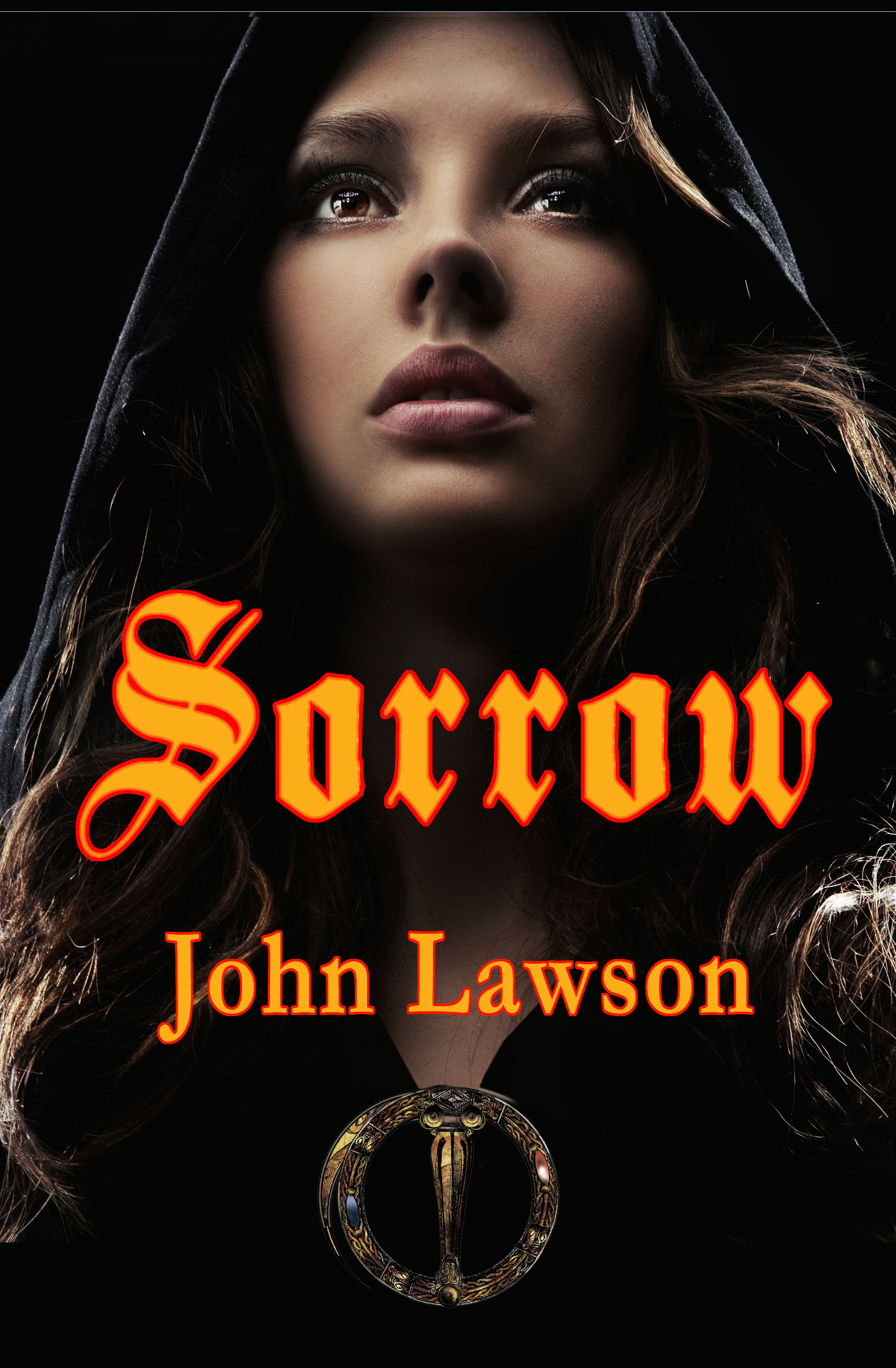
Sorrow is a story about a girl, Faina, who is way beyond her depth.  Once privileged, her family has lost its status and wealth, and as a guarantee against their debts, she’s been offered up as something of a marker.  She’s moved into the palace of a strange noble, where she’s watched and well cared for, but nonetheless a prisoner.
She’s a happy, energetic thing, and somewhat to the consternation of her keepers, she ends up bonding with the various servants and other local common folk, all of whom seem to adore her.  (Some of my favorite scenes are of her mixing with her friends and caretakers.)
But then the murders begin to occur — assassinations, really — for these people are living in a tumultuous, religiously volatile time, not unlike our own.  Important people are being killed, and that draws the attention of the duke.  He sends his man to deal with things, and it quickly becomes a contest between two very deadly assassins.  And poor Faina caught in the middle of it.
It is a much different book from my previous book, The Loathly Lady, taking place much later in time.  Instead of swords and torches, Sorrow offers flintlocks and gaslight.  It’s more political intrigue than high fantasy.  More Jason BournethanLord of the Rings.
What was your inspiration for Sorrow?
I wanted to write a coming-of-age story.  So often in entertainment, books, TV, movies, the protagonist in these kinds of stories are boys, so I wanted to diverge off-type somewhat and chose a female lead.  I wanted to try to express events like first love and loss through her perspective.
perf6.000x9.000.inddIn terms of settings, the courts of the EroBernd Empire and Vestiga Gæsi and the intrigue therein were inspired by such movies as “Rob Roy,” “Dangerous Liaisons,” the machinations of families like the Borgias.  In terms of the class struggles, I’ve drawn inspiration from Chaucer, Dickens, Dumas, Hugo, and Twain and contemporary movies such as “City of Men” and “Slumdog Millionaire.”
Did your book require a lot of research?
Yes, indeed.  I’m a compulsive researcher.  As a reader, it really pulls me from the story if some aspect strikes me as implausible or inaccurate, so as an author I do my best to keep things as grounded as possible.  Sure, I have magic and monsters and general fantasy weirdness, but they are realistic enough to the point where I hope the reader might imagine, “Yeah, that could happen.”  Language, culture, religion, ritual are all elements that I thoroughly research.  I keep copious notes and maintain a small encyclopedia of my world in the hopes of maintaining consistency (90% of which, I’m sure I’ll never end up using). 
What do you do when your muse refuses to collaborate?
I don’t sweat it.  I know some authors push through blocks, forcing themselves to write a certain amount of time a day, or a certain number of words.  I’m sure that’s a valid approach, and I’ve done it myself occasionally, but I don’t practice it as a rule.
I’m always thinking about my writing, even when I’m not actually writing.  Always looking for inspirations, jotting down notes, researching interesting words or factoids that I’ve found in other books or movies or TV shows.  I’m often my most productive on the treadmill.  All that cardio sends my mind into a different place.  Little sparks of inspiration come to me.  Alas, it is almost impossible to take coherent notes on my Kindle, so often afterwards I look at what I’ve written and have no idea what means. 
How do you keep your narrative exciting?
I don’t know.  Is my narrative exciting?  I hope it is.  At the very least, I hope it is interesting, surprising, and maybe even shocking.  I try to write the kind of books that I enjoy reading, filled with interesting, intelligent characters in interesting settings.  Often, the mayhem that ensues is a direct result of their interactions.  Some of my favorite scenes have absolutely no action whatsoever.  On the surface, they are merely conversations between people, but more emotion and firepower is exchanged between them than in any battle.  It’s great fun. 
How do you define success?
Creating a story that I enjoyed writing, being able to share it with others, and hopefully, they enjoying it.  I’m not out for money.  I’m not looking for a movie deal or fame or anything.  Just looking to share the stories.  My stories aren’t for everyone.  They’ll never be the next Twilight or Harry Potter, but I figure, with patience, they’ll find their audience.
My interview with the author was originally published in Blogcritics.

Book Review: ‘Sorrow’ by John Lawson


perf6.000x9.000.inddSorrow begins with a mysterious traveler on a mission, secretly carrying a box which contains a precious, powerful weapon.
Then the story moves to Vestiga Gaesi, where we meet Faina, the seductive yet naive fourteen-year old girl with a mysterious past who is staying at the Viscount’s luxurious home — where the story mainly takes place. Then, that night, an important Bishop is murdered, and Lord Ash is called to solve the case. It appears this isn’t the first crime committed against members of the clergy in the past few months. Thus begins his investigation. Soon, he has a suspect: Sorrow. Unfortunately, no one knows who this Sorrow really is, for this killer appears to be a supernatural creature that sheds black tears while killing. Who is Sorrow? Why are victims clergymen? What is Faina’s real identity and why is she in Vestiga Gaesi?
Lawson has created a very real, dark fantasy world that readers will be able to picture vividly in their minds. The descriptions, mood, and dialogue all help bring this story’s detailed world to life. The characters are deftly drawn and come across as genuine people. The prose sparkles with beautifully crafted language. Lawson’s strength lies in characterization and creating an imaginative dark world. I’d like to add that I found the details about religion and the clergy to be very well researched.
There’s an array of interesting characters with equal levels of importance that, together with intriguing twists and turns, will keep readers guessing: Phindol, the unfortunate traveler; Lord Ash, the detective who tries to solve the murder; and, of course, Faina, the alluring Lolita-like protagonist shrouded in mystery who seems to unwillingly seduce all men who set eyes on her. Though the writing is in good taste and there’s nothing graphic, I should mention that some of her scenes with Lord Ash and Phintol, both adult males, might be considered a bit disturbing to sensitive readers.
Sorrow is a standalone novel. However, it takes place in the same world — though hundreds of years apart — as Lawson’s previous novel, The Loathly Lady, also by Dragonwell Publishing.
Recommended for fans of dark fantasy who like a strong touch of mystery.
My review was previously published in Blogcritics Magazine.