Showing posts with label historical. Show all posts

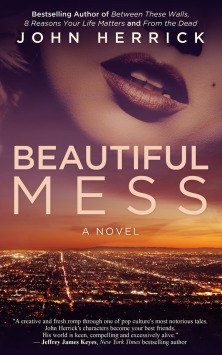
Excerpt reveal: Beautiful Mess, by John Herrick


Beautiful-Mess-Low-Resolution-Color-Book-CoverTitle
: BEAUTIFUL MESS
Genre: Fiction
Author: John Herrick
Website:  www.johnherrick.net
Publisher: Segue Blue
Find out more on Amazon
About the Book:
Protagonist Del Corwyn is an aging relic—an actor who climbed from errand boy to Academy Award nominee; who kept company with Hollywood’s golden era elite; who even shared a close friendship with Marilyn Monroe. But now, Del Corwyn is facing bankruptcy. Humiliated and forced to downgrade his lifestyle and sell the home he’s long cherished, Del is destined to fade into a history of forgotten legends—unless he can revive his career. All he needs is one last chance. While searching through memorabilia from his beloved past, Del rediscovers a mysterious envelope, dated 1962, containing an original screenplay by Marilyn Monroe—and proof that she named him its legal guardian.  Seemingly overnight, Del goes from bankrupt, washed up has-been to the top of Hollywood’s A-list. But the opportunity to reclaim his fame and fortune brings a choice: Is Del willing to sacrifice newfound love, self-respect and his most cherished friendship to achieve his greatest dream?
Beautiful Mess follows one man’s journey towards finding love and relevance where he least expects it—and proves that coming-of-age isn’t just for the young.
About the Author: A graduate of the University of Missouri—Columbia, John Herrick explores themes of spiritual journeys and the human heart in his works. Herrick’s debut novel, From the Dead, hailed as “a solid debut novel” by the Akron Beacon Journal, achieved Amazon best-seller status, while Herrick’s second novel, The Landing, was named a semifinalist in the inaugural Amazon Breakthrough Novel Award contest. Herrick’s nonfiction eBook, 8 Reasons Your Life Matters, received over 160,000 downloads and landed at #1 on Amazon’s Motivational Self-Help and Christian Inspiration bestseller lists.  His third novel, Between these Walls, garnered high critical acclaim, including Publishers Weekly’s prediction that “Herrick will make waves.” John Herrick is a native of St. Louis. Visit him online at: www.johnherrick.net
Connect with the Author on the Web:
BEAUTIFUL MESS
JOHN HERRICK
EXCERPT
            Arnie’s cheeks turned rosy as he grinned at Del. A wide, toothy grin. The discoloration of enamel betrayed a long-entrenched penchant for red wine. He rolled the script and slapped it against his palm.
“Do you realize how many people would dry-hump a flagpole to get their hands on this?” exclaimed the agent. “We’re talking history here! Hollywood’s best-kept secret!”
Del felt a bittersweet quiver in his gut but suppressed it. His life was about to become interesting again.
Arnie paged through the screenplay further, scanning the dialogue. Several minutes ticked past. Del savored the silence which, in this case, was the sound of power.
“Have you read this, Del?”
“I have.”
“Pretty deep shit in here. Dark shit, the kind that scares the hell out of you.” Arnie skipped to the screenplay’s midpoint and read some more. “And talk about explicit. The profanity, the sexual content, everything.”
“She made herself vulnerable, no doubt.”
“Damn, Del. This woman must’ve been more fucked up than we thought.”
Del winced. “Arnie, cut it out.”
“Sorry, I forgot you two were pals.” The agent shook his head in an absentminded manner, his mouth hanging open as he read further. “No wonder she didn’t show this to anybody else. Can you imagine how people would have reacted to this in 1962? The film would’ve been X-rated—if ratings had existed back then—and gotten banned from theaters. People would’ve protested outside. This script would’ve ruined Marilyn Monroe’s career.”
“But today—”
“—it’ll resurrect it.”
The men stared at each other for a moment, sizing each other up.
“But why you?” Arnie asked at last. “You said you two were buddies, but she knew tons of people. For all intent and purposes, she bequeathed it to you without realizing it. One of her final acts before she died. Why did she put this into your hands?”
Del shrugged. “I never betrayed her.”
He made his way toward a mini-fridge Arnie kept behind a bureau door and helped himself to a bottled water. He took a swig and began to pace the room, piecing the puzzle together with each stride.
“Many people aren’t aware of this,” Del said, “but her emotional state took such a dive, she was forced into a mental institution against her will for a brief period. That event left a permanent scar. Toward the end of her life, she didn’t trust many people, especially since people she trusted betrayed her and sent her to that place. Once she escaped, she feared the day would come when they’d lock her up again.
“This script exposed some of the inner workings and torments of her mind. What if authorities used it as evidence of a dangerous mental condition and sent her back to the one place she feared most? It was Joe DiMaggio, another ex-husband, who worked to get her out of there—and she barely made it out. If they had recommitted her, she would have lost her freedom forever.”
“But something must have prompted her to give this script to you, Del. If she was so paranoid, why did she risk giving the script to anyone? Why didn’t she keep it to herself?”
“She mentioned possible trouble ahead but didn’t go into detail.”
“You’re telling me Marilyn Monroe was a psychic?”
“Of course not. More like intuition. A sense that something was about to happen.” Del returned to his seat and crossed one leg over the other. He interlinked his fingers across his knee. “And she was right. A few months later, she died from a barbiturate overdose. Some speculated it was accidental, but the amount of drugs in her system were so high, it was hard to believe it was anything but suicide.”
Arnie tapped a pen against a legal pad. Del’s heart stirred. The memory of her death threatened to bring tears to the resilient man’s eyes.
Del leaned forward and locked eyes with his agent.
“For Marilyn, this script wasn’t about business. It wasn’t about fame.” Solemn, Del added, “This script is my chance to bring Marilyn Monroe back to life, one more time—on her own terms. To position her as a serious artist, the way she craved people to view her.”
“Your sentiment is honorable. That said, this revelation will set in motion a feeding frenzy.” Arnie paused, and Del caught a glint in his eye. “And I know you, Del. You like the cameras, the adoring fans. You want a career comeback—and this is the best ticket you’ll ever get.”
“Arnie—”
“All I’m saying is this: I don’t doubt your motive to honor Marilyn Monroe’s memory, but once we set this in motion, you’ll get caught up in the whirlwind. I’m warning you now because I don’t want to have to dig you out of a guilt complex later.”
“I’ll be fine, Arnie. Trust me.”
His agent regarded him for a moment, then nodded in resignation. “In that case, we need to set a plan in motion. How do we release the news of this discovery? How do we consider contenders? Where do we set the minimum bar for a deal? We get to call the shots here. They’ll need to play by our rules, and this script needs to be on strict lockdown.”
“Agreed.”
“In that case, the first thing we need to do is establish its authenticity. I’ll get the proof lined up and we’ll keep it in our back pockets. Next, we’ll hold a press conference to announce the existence of the screenplay—but let the press speculate about whether it’s authentic. We’ll hem and haw for a while, tease them a bit, make them think they have us cornered.”
Del didn’t want to look like a fool in public, regardless of how temporary or intentional, but he was willing to hear the rest of the idea. He stroked his chin and clasped his hands upon his chest. “And what happens next?”
“Then, when attention is at its peak, we release the evidence. It’ll be good for another round of marketing. So instead of releasing the evidence at the first news conference, we’ll get twice the bang for our buck.”
“Makes sense to me.” Del felt much more at ease. He exhaled and took a swig of water. The bottle’s thin plastic crackled in his grip.
“We’ll need some time to strategize this while the thumbprints are verified. I know a guy who can get it done under the radar. Meanwhile—and I’m sure you know this, but I’ll stress it anyway—don’t breathe a word of this until the day of our big announcement. Not to the media, the studio people, producers—not even to the chef at your sushi restaurant. The element of surprise will strengthen our bargaining position. Agreed?”
“Agreed.”
Arnie exhaled, as though in relief, and scratched his bald head. His fingers left behind red streaks. “This is big, Del.”
Del’s pulse increased with anticipation, yet he maintained his composure. He finished his water and crumpled the bottle.
‘Big’ didn’t do it justice.
This wasn’t just Marilyn’s final chance.
It was Del Corwyn’s, too.

Book Review: The Last Wife of Attila the Hun, by Joan Schweighardt


The Last Wife of Attila the Hun by Joan Schweighardt is an ambitious, superbly researched, excellently written novel based on Germanic legends and the true life of Attila the Hun that will mesmerize fans of historical fiction. There isn’t a lot of fiction based on Attila, so being a lover of history I was instantly intrigued about reading the book.
The novel moves back and forth in time, interweaving two stories. In one, we meet Gudrun, a brave Burgundian noble woman with a lethal mission, destroy the infamous Attila the Hun. In the other, the reader travels to the past to learn the overwhelming events that brought Gudrun to this difficult, suicidal undertaking.
From the beginning, Schweighardt’s imaginative storytelling and attention to detail shine through the pages, bringing Attila’s fifth century landscape to life in all its gritty vividness. Characters are deftly drawn, and I found myself instantly sympathetic to Gudrun’s situation, as well as absorbed by the other characters. This was especially true of Attila’s second in command, with whom Gudrun develops an unusual relationship. Attila himself is portrayed in chilling detail.
Needless to say, I love the fact that the story is seen from a female perspective. At times, her focused obsession for revenge propels the tale at a breathless pace. Juxtaposing with her present life as Attila’s prisoner are her memories of her great yet tragic love with Sigurd.
I’m not surprised the novel has won awards and it’s been translated into other languages. Dark, mysterious, and beautifully layered, The Last Wife of Attila the Hun is filled with lust, revenge and passion, and comes highly recommended by this reviewer. If you’re a historical fiction enthusiast, this is for you.
Find out more about Joan Schweighardt here. Read my interview with her on Blogcritics. Purchase the book on Amazon

Cover Reveal: The One Who Sees Me, by Kandi J. Wyatt

Looking for a new read?
 
It's cover reveal time!
 
Booktrope Publishing brings you the latest in Historical Christian Fiction...
 
THE ONE WHO SEES ME
SYNOPSIS
Teenage slave girl Faru’s life has been turned upside down when she discovers she’s been traded to a new master, forcing her to leave all she‘s ever known. Upon her arrival, Faru meets a friend, Cailean, who helps her adjust to life in the strange location. Life settles into a new pattern, and romance blossoms between the young friends. But as soon as they plan to get married, another proposal comes about – one that cannot be ignored. Being a slave means not always marrying who you love.
On a daring journey to heal her heart, Faru encounters the Existing One. Will she trust Him and do His bidding even if what He requests is so hard?
Follow Faru’s tale in author Kandi J Wyatt’s retelling of a Biblical story found in the Old Testament book of Genesis, showing that when things don’t make sense, God will guide the way.
 
Author Bio & Social Media Links for The One Who Sees Me
Author Bio: 
Kandi J Wyatt is a wife, mother of five, teacher, artist, and author. In her free time, she enjoys writing fantasy stories and Christmas programs, and drawing with graphite and colored pencils. Portraits are her specialty. Kandi also enjoys photography, thanks to her photographer husband who has let her join his journey as both his model and apprentice, and she occasionally serves as his assistant when he needs a “light stand with feet.” To learn more, visit Kandijwyatt.wordpress.com.

Interview with Sophia Bar-Lev, Author of ‘The Silver Locket’


Author PhotoA native of Massachusetts, Sophia Bar-Lev divides her time between the Fort Worth, Texas area and Israel.  A former school teacher and adult education lecturer, Bar-Lev now devotes the majority of her time to writing.  Sophia Bar-Lev is also the author of Pasta, Poppy Fields, and Pearls and Pizza and Promises. The Silver Locket is her latest novel.
Connect with the author on the web:
Q: Congratulations on the release of your latest book, THE SILVER LOCKET. To begin with, can you gives us a brief summary of what the story is about and what compelled you to write it?   
A: This novel is celebrates the triumph of the human spirit over tragedy and heartache.  It chronicles the lives of two women whose lives are linked by a child that belongs to both of them but in different ways.  Their common devotion to motherhood and family ultimately leads to a powerful and fulfilling reunion. The power of a sensitive and difficult decision years earlier is realized as two families join their hearts and lives because of one special daughter they share. My inspiration came from the true story of a friend who wanted her story told and was delighted that I would write it for her.
Q: What do you think makes a good contemporary novel? Could you narrow it down to the three most important elements? Is it even possible to narrow it down?
A: A novel doesn’t deny reality; it interprets reality.  The novels I appreciate and enjoy reading relates to the contemporary reader in a way that adds value to his/her life. This what I endeavor to do in my writing.  The importance of character development cannot be overstated.  Imagination must blend seamlessly with realism to produce for the reader a sense of connection or identification with the personalities in the book.
Q: How did you go about plotting your story? Or did you discover it as you worked on the book?
A: In the case of THE SILVER LOCKET, I knew the basic story ahead of time so my primary task was to follow the real life plot as told to me by my friend.  However, in my other novels, I start with an idea which morphs into an overview but as I write, very often the characters pull me into directions I didn’t anticipate when I started the project.  Personally, I’ve never outlined a book ahead of time.  I tend to write more spontaneously and, as they say, ‘go with the flow’.
Book Cover - The SIlver LocketQ: Tell us something interesting about your protagonist and how you developed him or her. Did you do any character interviews or sketches prior to the actual writing?
A:  For this novel I invested considerable time in learning everything I could about the two women who are the primary characters throughout the novel.  My friend’s descriptions and insights into her birth mother and adopted mother were very helpful and gave me a solid basis for building the narrative.  Yes, I did write up two character interviews while I was writing the book and later revised them after the book was finished.  I found the practice very helpful not only for this novel but for my other novels as well.
Q: In the same light, how did you create your antagonist or villain? What steps did you take to make him or her realistic?
A: This took a bit more imagination than the development of the protagonists.  Actual information about this person was sketchy so I did some research into the general traits of the kind of person he needed to be in the story and received some advice from a local police officer as well, not only regarding the criminal but also about the types of laws applicable at the time.
Q: How did you keep your narrative exciting throughout the novel? Could you offer some practical, specific tips?
A: To keep a reader turning the pages requires enough mystery or suspense to create continual curiosity.  As a writer moves through the chapters, unexpected twists to the story act like bait to ‘hook’ the reader to keep going.  In this novel, I inserted events and conversations at strategic intervals to create or increase the suspense and add depth to the story.
Q: Setting is also quite important and in many cases it becomes like a character itself. What tools of the trade did you use in your writing to bring the setting to life?
A: Descriptions must be written in such a way that the reader can paint a picture in his/her mind of the various settings in the course of the novel.  Carefully chosen words, similies, analogies and references will all contribute to dynamic settings so that – in a manner of speaking – the book becomes a movie in the mind of the reader.
Q: Did you know the theme(s) of your novel from the start or is this something you discovered after completing the first draft? Is this theme(s) recurrent in your other work?
A: In this case, yes I knew the theme from the beginning.  In my other novels, I had a general idea but the themes developed as I wrote so that by the time I completed each novel, the theme was clear and distinct.
Q: Where does craft end and art begin? Do you think editing can destroy the initial creative thrust of an author?
A: Craft and art – art and craft: which comes first? Hard to say. I think the most successful novel is the result of free-flowing ‘art’ or creativity, which is later reviewed, revised and edited so that the level of the craft enhances the art contained within the novel itself.
Q: What three things, in your opinion, make a successful novelist?
A: Persistence, diligence and a passion for excellence are imperative for any writer to become a successful novelist.  Actually, I think these three qualities are essential for success in any area of life but as we’re discussing authors, I would add that every author has to be willing to throw away as much or more than they actually publish.  Writing is a ‘practice’ as well as an art.  I write every day and much of it ends up in the dust bin but it’s not wasted time; it’s practice and practice makes perfect.
Q: A famous writer once wrote that being an author is like having to do homework for the rest of your life. What do you think about that?
A:  I love writing so if this is homework for the rest of my life, bring it on!  I’m a firm believer in the maxim that if you love what you do, you won’t ‘work’ for the rest of your life.  Your ‘work’ becomes your joy.
Q: Are there any resources, books, workshops or sites about craft that you’ve found helpful during your writing career?
A:  Yes I regularly read postings from Writers’ Digest and subscribe to their magazine as well. I attend writers’ workshops as often as I can and read books about writing.  I found Stephen King’s book, ON WRITING and BIRD BY BIRD by Anne Lamott helpful and inspiring.  I’m also a great fan of the series of books for writers by Julia Cameron.  Her works continue to be a resource I go back to frequently.
Q:  Is there anything else you’d like to share with my readers about the craft of writing?
A: I have a small book on my desk which a friend recently sent me.  It’s entitled, YOU’RE A WRITER SO ACT LIKE IT.  I haven’t read the book yet but I love the title.  Anyone who aspires to be a writer needs to put in the time to develop the skills that a creative imagination requires in order to marry ideas to effective expression.  I daresay there are many potential writers who are not lacking in ideas but in the will and persistence to do the work required to turn their imaginations into printed material.  Great ideas are not enough; the mechanical skills for producing a winning manuscript are essential.  And that, my friends, takes work.
////////////////////////////////////////////////
Title:  THE SILVER LOCKET
Genre:  Women’s Fiction
Author:  Sophia Bar-Lev
Purchase on Amazon
About the Book:
When The Silver Locket opens, it’s July 1941 in Boston, Massachusetts. War is raging in Europe and the Pacific. But for two young women in a small town in New England waging their own personal battles, the struggle is way too close to home.
When extraordinary circumstances bring these two women together, one decision will alter the course of their lives.  And with that one decision, their lives will be forever changed…and forever intertwined.
Were these two women thrust together by happenstance—or fate?   A tragedy. A decision. A pact. Lives irretrievably changed. A baby girl will grow up in the shadow of a secret that must be kept at all costs. But will this secret ever see the light of day?  And what happens when—or if—a promise made must be broken?
Adopting a child is not for the feint of heart—but neither is being adopted…
A sweeping and suspenseful story that unfolds in a different time and a different place, The Silver Locket explores universal themes that ring true even today. Secrets. Unbreakable bonds. The healing power of love.  Deception. Anguish.  Redemption.
In this touching and tender tale, novelist Sophia Bar-Lev weaves a confident, quietly moving story about adoption, finding hope in the face of hopelessness, and how true love can overcome any obstacle. With its brilliant juxtaposition of the wars fought both on the battlefield and internally, The Silver Locket is a poignant novel, resplendent with drama.  Featuring an exceedingly real and relatable plot, and characters that will stay with readers long after the final page is turned, The Silver Locket is a sterling new read.

Guest Post by Eleanor Parker Sapia, Author of 'A Decent Woman'

PUBLISHED BOOK COVER (front)I wrote the first draft of my historical novel, A Decent Woman, as a stay at home Mom in my late forties, while living in Brussels, Belgium with my husband and two children. By that time, I’d been an exhibiting artist for twenty years. A year later, my kids left for university, and I moved back to the United States as a single woman. There was no preparation for this—one day I was married and secure, financially and emotionally. The next day I was separated from my husband and had no real security, no job, and a future I couldn’t see. I immediately went to work and became a full time student while my kids worked on their own degrees. When they graduated and found good jobs, I made a life decision—I quit my job, bought a house in West Virginia, and packed my bags. When I describe that time as jumping off a cliff to save my life, I mean it; that’s what it felt like. But I knew it was the right thing to do. I had a novel to finish.
When I unpacked the manuscript I’d written several years before, I discovered that the story I’d written as a married woman no longer ‘fit me’, nor did it represent the story I needed to tell. As I looked back upon my life post-divorce and pre-publication, I realized all my wonderful, difficult, and challenging life experiences—personal and work-related—were in preparation for writing A Decent Woman; nothing I experienced was wasted.
As I rewrote the story, I filtered bits and pieces through my work experiences as counselor, social worker, refugee case worker, a staff member at a residential treatment center/school, an alternative health practitioner, and exhibiting artist. Stories told by my mother and my maternal grandmother, both born in Ponce, Puerto Rico, about their lives, and especially my grandmother’s stories about her Afro-Caribbean midwife, who caught my mother, two aunts, and my uncle, inspired the character of Ana Belén. Ana became an Afro-Cuban midwife born into slavery, who struggles to survive in male-dominated Puerto Rico. The story felt right.
It was eye-opening to compare the first manuscript with the final version, and I had an aha moment when I realized I could never have breathed the same life into Ana and the women of A Decent Woman—the women of different social classes, white and black, rich and poor, educated and illiterate, if I’d remained safe and secure in the soft cocoon of my married life. By struggling, scrimping, learning to fend for myself, I could finally understand Ana’s plight and her life, well enough to write her story.
////////////////////////////////////
profile-pic (1)Puerto Rican-born novelist,Eleanor Parker Sapia, was raised in the United States, Puerto Rico, and Europe. Eleanor’s life experiences as a counselor, alternative health practitioner, a Spanish language social worker, and a refugee case worker inspire her passion for writing. When Eleanor is not writing, she facilitates creativity groups, and is making plans to walk El Camino de Santiago a second time. A Decent Woman is her debut novel. Eleanor is the mother of two adult children, and she lives in West Virginia.
About the Book 
Ponce, Puerto Rico, at the turn of the century: Ana Belén Opaku, an Afro-Cuban born into slavery, is a proud midwife with a tempestuous past. After testifying at an infanticide trial, Ana is forced to reveal a dark secret from her past, but continues to hide an even more sinister one. Pitted against the parish priest, Padre Vicénte, and young Doctór Héctor Rivera, Ana must battle to preserve her twenty-five year career as the only midwife in La Playa.
Serafina is a respectable young widow with two small children, who marries an older wealthy merchant from a distinguished family. A crime against Serafina during her last pregnancy forever bonds her to Ana in an ill-conceived plan to avoid a scandal and preserve Serafina’s honor.
Set against the combustive backdrop of a chauvinistic society, where women are treated as possessions, A Decent Woman is the provocative story of these two women as they battle for their dignity and for love against the pain of betrayal and social change.
Find out more on Amazon.