Showing posts with label military. Show all posts

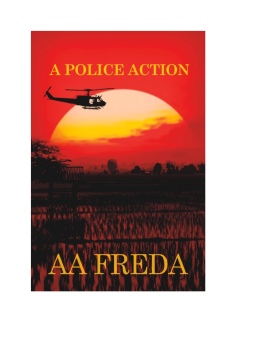
Excerpt reveal: A Police Action, by A.A. Freda


A Police Action Cover jpegTitle:  A Police Action
Genre:  Coming of Age Novel
Author: A.A. Freda
Website:  www.aafreda.com
Publisher: Dorrance Publishing
Find out more on Amazon
Award-winning novelist A.A. Freda received high acclaim for his debut novel, Goodbye Rudy Kazoody.  In his second novel, A Police Action, Freda delivers a gripping Vietnam era novel about two lost, confused young adults, Samantha Powers and James Coppi.   A Police Action has garnered high early praise:
“Well written and historically accurate, A Police Action is a reminder of what the 1960’s were really like, for better or worse.”
—Foreword Clarion
“Fluid, beautifully crafted, and emotionally rich. A brilliant intersection of coming-of-age and romance.”
—Manhattan Book Review
“An engrossing tale that moves deftly from the battlefield to the heart.”
—Midwest Book Review
“A spellbinding story with a powerful setting”
—Readers’ Favorite
About A Police Action: It is love at first sight when nineteen-year old Samantha Powers meets James Coppi at the Country Honky Tonk in Colorado Springs. There are just two problems standing in the way of a storybook ending for Samantha’s passion:  she is pregnant with someone else’s child—and James, a young soldier, is heading for a war in Vietnam.  But is there something more to this instant attraction?  And what will happen after James is deployed? Will he return home safely, and, if so, will it be for Samantha?  For James and Samantha, it seems uncertainty is the only certainty.  A moving story that unfolds as James and Sam mature through individual and shared hardships, A Police Action is unforgettable. 
A solid and thought-provoking novel, A Police Action is a richly textured tale resplendent with vivid historical detail.  In this unique story that blends elements of coming-of-age, romance, and historical fiction, novelist A. A. Freda captures the atmospheric, turbulent late 60s, the heady rush of young love, and the unmistakable restless uncertainty of youth.  A powerfully realistic story informed by Freda’s own experience in Vietnam, A Police Action brings to life the spirit and the struggles of the 60s.  With its engaging premise, multi-dimensional characters and gripping storyline, A Police Action is an extraordinary tale extraordinarily well told.

Chapter 1
The Launching Point
Coppi’s definition of a lifer is any man who enlisted to join the service, any soldier that has the initials RA on his dog tags, RA standing for Regular Army. Draftees, like Coppi, are not lifers. Their dog tags begin with the letters US, which stands for United States. The army probably doesn’t even consider them regular soldiers.
To Coppi, there is also a difference between a lifer and a true lifer. A lifer is a mixed-up jerk who joined the army for some stupid reason, probably to get away from something in his pathetic life on the outside. Once in the army, the poor slob realizes his mistake and wants to go home just as much as a draftee does. Unfortunately for him, his mistake will cost him an extra year of active duty.
A true lifer is a loser who has made the military a career.
• • • • •
Specialist Fourth Class James Coppi comes out of the company headquarters where he’s just reported for duty, early one mid-April evening, picks up his duffel bag, and heads to the barracks. A drab gray building of horizontal planks, it looks the same as all the other barracks he’s seen since being drafted. It makes him long for home for a minute—but just a minute—and then the beautiful Colorado evening with its night sky already full of stars reminds him that the Bronx was no Garden of Eden, either.
Coppi hasn’t seen so many stars in the sky since he was a young boy in his native Italy. The air is already beginning to freshen, a cool breeze moving across his face and carrying with it the aroma of those fields of bright-blue flowers he saw out the window of his plane as it landed earlier. What were they called … Texas bluebells? Yes, that’s the name. The sight of acres of deep sky blue blooms had stayed with him. There is something else in the air, too—a chill following not far behind the fading sun and the fragrance of the flowers; he wouldn’t be surprised if during the night there’s a late-spring freeze. He’s read that the night temperature in the Rockies can easily drop fifty degrees.
He still can’t believe he’s headed for Vietnam. Only ten months left on his tour—he’d thought he was in the clear. What draftee goes to Nam in his last ten months? He will have only six months remaining on his service when this unit heads out, sometime in July. The army must be really hard up for men. The news coming from the conflict is bad. The Tet Offensive, mounted by the North Vietnamese Army, has shown the general public that victory for the Americans, as assured them by the politicians, is not imminent. The news is so bad that Lyndon Johnson has dropped out of his reelection bid. The stubborn fool still won’t accept reality and defeat. So, what’s his plan…to increase the forces fighting in Southeast Asia to more than five hundred thousand? To what end?

On the Hot Seat: 5 Questions with Horror Author Patrick C. Greene

As a toddler, Patrick C. Greene was creating horrors in crayon and magic marker upon every available surface. Not surprisingly, he soon discovered comic books and immersed himself in the fantastic worlds found therein. Horror fiction and films came next, and despite spending nights of terror hiding under covers, he always found himself drawn back to tales of dark fates.
Greene cut his fangs in the screenwriting business but found his true calling in the world of prose fiction of the kind his heroes King, Barker and Koontz create.
Living at night, deep in the mountains of Western North Carolina, Greene answers the call of his morbid muse when not enjoying monstrous helpings of horror, kung fu and doom metal.
Q: What’s inside the mind of a horror author?
A: Many surprisingly bright and cheery thoughts, actually. If I may speak for purveyors of the genre, I find my colleagues to share with me a wish for social equality and peace, for beauty/ truth. The horror, with its allusions to the unknown and Unknowable, is both a distraction from mundane bothers and a reflection of the current world state; how it could be so much better with just a little effort.
Q: Tell us why readers should buy The Crimson Calling.
A: Vampires are endlessly fascinating because they are the monster closest to us, in terms of emotional complexity, desire and ambition. They too can feel love of a kind –or try to reject it. The vampires of Crimson are both terrified of and fascinated by us “warmies,” just as we are of them. We are on the cusp of a time when vampires and mortals can find a kind of peace, but the road is fraught with treachery and danger. It’s a close parallel to some of our current social issues, and even mingles with those at times. Oh yeah – the question. Readers should buy The Crimson Calling because it is literally the Single Greatest Accomplishment in Human History.
Q: What makes a good vampire horror novel?
A: The element that makes a book of any genre good, is its characters first, and how they handle the conflicts of the story second. It’s not enough for vampires to be scary in my opinion, they must also have very human thoughts and feelings. A werewolf or zombie for example, isn’t necessarily evil, just hungry and unconcerned with what it destroys in satisfying that hunger. A vampire must be aware of the lives of their victims and either ignore them or relish the pain and change they reap.
Q: What is a regular writing day like for you?
A: Not really a “day” at all. I’m very much a night creature, like the vamps of The Crimson Calling, but without the sometimes messy habits. I’m up in the early evening, off to the gym for a couple of hours, and then on to work on the latest project, wrapping up by dawn. The training settles my body so that my mind can be active, and also helps me to clear stress so that the writing time is most constructive.
Q: What has writing taught you?
A: It’s a constant reminder of the theory of relativity, that every reaction has its opposite. But also, that the opposite can be something wildly unexpected. It has instilled in me the appreciation of having a long term goal and seeing it realized past the doubts and fog of the early stages. So, patience, mostly.

Guest Post: "The Inspiration behind The Cavalier Spy," by S.W. O’Connell

TheCavalierSpy_medIn many ways, The Cavalier Spy should have been an easy book to write. After all, it is the sequel to the first book in the Yankee Doodle Spies series, The Patriot Spy, so many of the characters, themes and settings were in place when I began the book. But ironically, that made the book all the more difficult. Why? Because I wanted The Cavalier Spy to stand on its own. I wanted readers who had not read the first book in the series to enjoyThe Cavalier Spy as much as those who did read The Patriot Spy. I had no idea how hard that would be. And starting out, I had no idea how I would do it. But then I began to write and the story took over, as it often does.
The story has three general settings. I think that helped. In fact, the settings are essential to the building of the tale. This is, after all, a historical novel and I am trying to portray history through fiction. And history is about places, as well as people. The first setting is New York. The second is the area around the Hackensack Valley of New Jersey. The third setting is “western Jersey,” the area along the Delaware River. During the time of the American Revolution New Jersey was often referred to as “the Jerseys.” The Jerseys were east and west Jersey. East Jersey is that part of the state that borders New York and the North (Hudson) River. West Jersey is the portion that borders Philadelphia and the Delaware River.
Since the first setting was the same as that of The Patriot Spy, and as I began to draw out the plot, I used the setting to refer back to events that unfolded in it. I did not plan this. It just came to me as I wrote. An example is when the protagonist, Jeremiah Creed and his men are sent behind British lines he decides to go by the post house in Yorkville. There he “re-recruits” young Thomas Jefferies to the cause. I use those scenes to flash back to how they originally met, and the events that drew them together. As Creed drives deeper into British occupied New York, people he encounters and venues provide opportunities to briefly let the reader in on what happened in book one. Another challenge for the writer is to do this without making things tedious for those who read the first book. The trick is to keep the flashback short. Usually a couple of sentences. The trick is to do this without tying up the story too much and break the flow. As the story progresses to the other two settings, the need and opportunity to do this fades away. Soon the story is standing on its own legs and the reader is caught up on what happened.
Another interesting challenge I faced was telling the tale of how my protagonist arrived in America. In The Patriot Spy I hinted that he was an immigrant. InThe Cavalier Spy, I show it. But how to get there without distracting too much from the main plot, Washington’s desperate attempt to avoid defeat and his use of intelligence to aid those efforts. The idea came to me suddenly. I would have Washington and his fictional “Senior Intelligence Advisor” conduct what is essentially a “subject interview” of Creed. They confront him on his mysterious past and want to “vet” him. He decides to tell all in a “confession” to his commander in chief. Don’t worry. He doesn’t really tell all. Some things have to be saved for future books. But we do get a several chapter flashback out of it. And I had a lot of fun writing it.
By time I got to the Hackensack Valley setting, I was thoroughly enjoying myself. I was able to create a fictional village and spin some interesting characters in and out of it. But in doing it, I reveal an interesting and little noted fact about the American war for Independence. It was a complex struggle and a local one. New Jersey raised some impressive Loyalist troops for the King and one of those regiments plays a role. The Hackensack Valley had a significant Dutch populace. After all, East Jersey was part of the Dutch colony (along with New York) of New Amsterdam. This provided me some rich characters to develop. It is in this setting that I bring the strange case of “Mister X” into the story. Weaving a controversial historic figure into the plot was intriguing to me, the writer. I hope it is for the reader as well.
The last setting is West Jersey. This is the iconic “times that try men’s souls.” The new nation’s hopes are all but dashed. Washington escapes the British but is now ignominiously holed up on the far bank of the Delaware River and his army has evaporated. To have any hope of saving his army and the cause, Washington must send Jeremiah Creed back into the bosom of the enemy. A key ingredient, almost a character, in this setting is, believe it or not, Mother Nature. A cold winter is gripping the Delaware Valley and it has a role in everything. The characters (and their horses) are affected. The Continental Army is affected. And most importantly, the British Army is affected. The despair that unfolds in the first two settings culminates in desperation. And this desperation sets in on both the fictional and historical characters. Washington is desperate to save his Army and the Revolution. Creed is desperate to do his duty. And the British are desperate not to lose what they have achieved. But desperation breeds valor and resourcefulness. But it can also breed mistakes. And ultimately, the fortunes of men and of nations, can turn on mistakes.
oconnell_author_photo090315
ABOUT THE AUTHOR
S.W. O’Connell is the author of the Yankee Doodle Spies series of action and espionage novels set during the American Revolutionary War. The author is a retired Army officer with over twenty years of experience in a variety of intelligence-related assignments around the world. He is long time student of history and lover of the historical novel genre. So it was no surprise that he turned to that genre when he decided to write back in 2009. He lives in Virginia.
////////////////////////////////////
Title: The Cavalier Spy
Genre: Historical
Author: S. W. O’Connell
Publisher: Twilight Times Books
About the Book:
1776: His army clinging to New York by a thread, a desperate General George Washington sends Lieutenant Jeremiah Creed behind British lines once more. But even the audacity of Creed and his band of spies cannot stop the British juggernaut from driving the Americans from New York, and chasing them across New Jersey in a blitzkrieg fashion. Realizing the imminent loss of one of the new nation’s most important states to the enemy, Washington sends Creed into the war-torn Hackensack Valley. His mission: recruit and train a gang of rogues to work behind British lines.
However, his mission takes a strange twist when the British high command plots to kidnap a senior American officer and a mysterious young woman comes between Creed and his plans. The British drive Washington’s army across the Delaware. The new nation faces its darkest moment. But Washington plans a surprise return led by young Creed, who must strike into hostile land so that Washington can rally his army for an audacious gamble that could win, or lose, the war.
“More than a great spy story… it is about leadership and courage in the face of adversity…The Cavalier Spy is the story of America’s first army and the few… those officers and soldiers who gave their all to a cause that was seemingly lost…”
~ Les Brownlee, former Acting Secretary of the Army and retired Army Colonel
“Secret meetings, skirmishes and scorching battles… The Cavalier Spy takes the reader through America’s darkest times and greatest triumphs thanks to its powerful array of fictional and historical characters… this book shows that courage, leadership and audacity are the key elements in war…”
~ F. William Smullen, Director of National Security Studies at Syracuse University’s Maxwell School and Author of Ways and Means for Managing UP

"On Writing a Military Novel," by Jonathan Raab, Author of 'Flight of the Blue Falcon'

My military service—and the service of those around me—wasn’t anything special.

I didn’t serve in some elite black ops unit. I spent a relatively short amount of time in-country. And my deployments were, on the whole, both very, very boring.

That mundanity is precisely why it was important that I wrote about it. While our culture is quick to celebrate war heroes—those figures who meet extreme circumstances and rise above them, or endure in the face of incredible hardship—of less note and renown is the typical soldier, the average grunt, or the lowly Joe just doing his job.

Societies have always celebrated their heroes—those who do more, those who achieve more. That’s great. But if we only focus on the stories that are propaganda worthy, we lose something of ourselves. The average person who serves in war has a story to tell, and that story is important. It’s important precisely because so many can relate to it.

In Flight of the Blue Falcon, I describe a lot of the soldier’s day-to-day activities. It’s mundane, sure, but it’s also important. It’s funny. It’s surreal. It’s bizarre. It’s frustrating. Not everyone serves in the military or in a time of war, but everyone has a job that they hate, at one time or another. They have a boss that drives them nuts. They experience hardship, misunderstanding, alienation. They find their dreams slipping away. Their relationships fraying. Their self-respect taking a hit.

Everyone can relate to those things.

Military service—real, rough, dangerous service—brings these moments and periods of self-reflection and doubt to a whole new level. Good military novels are essentially books about the American workplace, the American dream, writ large against tragic circumstances, with high-stakes moments that go well beyond the typical. And yet, if you’ve ever spent any amount of time with line soldiers, you realize that they are typical. They are just regular folks, trudging through the day to day of their lives, their jobs. Even if you’ve never served, you’ll see yourself in them. You’ll see your friends, your family, your co-workers in the faces and stories of these men and women in uniform.
That is precisely why, not in spite of but because of the mundanity of military service, we should tell our stories. Our stories of being bored, of being hopeful, of being challenged with loss and even death. The experience of the average is valuable, because in the average, we can see ourselves. We can be connected with one another, even across cultures, time, and experience. 

/////////////////////////////////////
Title: Flight of the Blue Falcon
Genre: Fiction – Adult
Author: Jonathan Raab
Publisher: War Writers’ Campaign, Inc.
Watch the Trailer
Purchase on Amazon
About the Book:
FLIGHT OF THE BLUE FALCON
By
JONATHAN RAAB
“Jonathan Raab is not only a genuine advocate for veteran causes, he is a preacher of their tales; both fiction and nonfiction. His writing will immerse you into a combat environment that parallels the imagination of those who have never had the pleasure.”
—Derek J. Porter, author of Conquering Mental Fatigues: PTSD & Hypervigilance Disorder
“Jonathan Raab uses his experience to illustrate the raw world of the common soldier. His masterful use of edgy humor and intellectual commentary creates a space for discussing the military culture.”
—Nate Brookshire, co-author, Hidden Wounds: A Soldiers Burden
In FLIGHT OF THE BLUE FALCON (War Writers’ Campaign; July 2015; PRICE), a chewed-up Army National Guard unit heads to a forgotten war in Afghanistan where three men find themselves thrust into the heart of absurdity: the post-modern American war machine. The inexperienced Private Rench, the jaded veteran Staff Sergeant Halderman, and the idealistic Lieutenant Gracie join a platoon of misfit citizen-soldiers and experience a series of alienating and bizarre events.
Private Rench is young, inexperienced, and from a poor, rural, broken home. He’s adrift in life. The early signs of alcoholism and potential substance abuse are beginning to rear their ugly heads. He wants to do right by the Army, but doesn’t quite know who he is yet.
Staff Sergeant Halderman has one previous combat tour under his belt. He got out, realized his life was going nowhere, so re-enlisted to serve with the men he knew, and to lead the inexperienced guys into combat. He is manifesting the early signs of post traumatic stress, but is too focused on the upcoming mission to deal with it. He sees the Army for what it is—a big, screwed up machine that doesn’t always do the right thing—but he doesn’t think all that highly of himself, either.
Second Lieutenant Gracie is fresh, young, excited to be in the Army, and trying to adjust to the new to the military and his life as an officer. Although he faces a steep learning curve, he is adaptable and has a good, upbeat attitude. As he tries to forge his own path, he nonetheless turns to the experienced NCOs in his unit for guidance and support. He must continually make tough decisions that have no “right” or textbook answers. Yet these decisions are catalysts enabling him to grow in maturity, experience, and wisdom.
Preparation for combat is surreal: Rench is force-fed cookies by his drill sergeants. Halderman’s “training” is to pick up garbage in the blistering heat of the California desert for four days straight. Gracie contends with a battalion commander obsessed with latrine graffiti.
Once they reach Afghanistan, things really get weird.
FLIGHT OF THE BLUE FALCON is the story of three men who volunteer to serve their country. It’s about what it means to be a soldier, to fight, to know true camaraderie—and to return home.
This is a war story. This is their story.
Only the most unbelievable parts are true.
jonathan
About the Author
Jonathan Raab is a veteran of the Afghanistan war, where he served as an infantryman assigned to a combat advisor team. He is the editor-in-chief of Muzzleland Press and an editor for the War Writers’ Campaign. His work has appeared in The New York Times’ At War Blog, CNN.com, the Military Success Network, Literati Presents, The Stars and Stripes, and many others. His second novel, The Hillbilly Moonshine Massacre, will be available in late 2015. He lives in the Denver metro area with his wife Jess and their dog, Egon.
Connect with Jonathan Raab on the Web: Website / Facebook /Twitter